Duvets, comforters, and quilts are among the most essential layers of bedding; though all of them serve the same basic purpose (keeping people warm and comfortable), they differ significantly in construction, performance, ease of care, and cost.
A duvet typically consists of a soft insert paired with a removable cover, making it easy to clean and customize for different seasons. A comforter, on the other hand, comes as a single, sewn-together piece with its cover built in. Meanwhile, a quilt features an insulating layer stitched between two pieces of fabric, often with decorative or patterned designs that add aesthetic appeal in addition to warmth.
Choosing the right one for your property affects guest comfort, laundry cycles, replacement costs, and aesthetics.
In this guide, our experts break down the pros and cons of each (especially for hospitality properties), and share tips for care, selection, and positioning them in your linen inventory.
Table of Contents
Quilt vs Comforter vs Duvet — Side-by-Side Comparison
Before going into the details, let’s look at the quick summary table for the difference between a quilt, duvet, and comforter.
| Feature | Quilt | Comforter | Duvet (Insert + Cover) |
| Warmth / Loft | Light to moderate, thinner insulation | Moderate, dependent on fill | Can choose heavy or light inserts |
| Breathability / Climate Suitability | Excellent for warm climates | Mid-range | Can adapt (light or heavy insert) |
| Ease of Maintenance | The entire quilt must be washed | Entire comforter must be washed | Only cover washed frequently; insert less often |
| Design Flexibility | Static design (unless reversible) | Static design | High flexibility via interchangeable covers |
| Durability (in high-turnover / frequent washing) | Depends on stitching & materials | Prone to wear over time | Longer due to protective cover |
| Cost (initial & long-run) | Medium to low (depending on quality) | Medium | Higher initial, but better longevity / cost per use |
| Drawbacks / Risks | May not suffice in cold seasons | Bulky to wash, less flexible | Insert shifting, higher cost, more complex setup |
From the table, you can see why a duvet system is often optimal for guest bedding: it allows you to balance comfort, aesthetics, and maintenance cost.
What Is a Duvet?

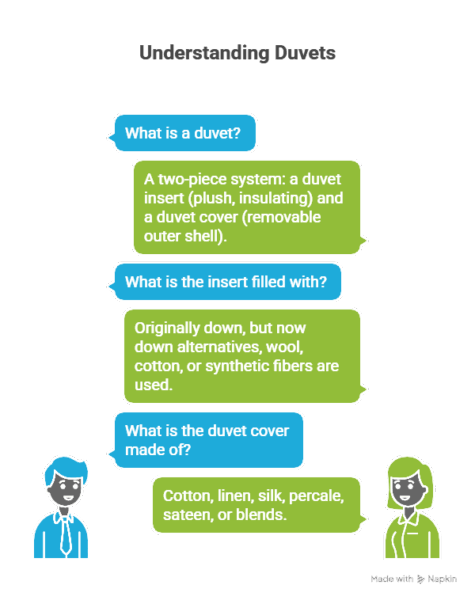
A duvet typically refers to a two-piece system: a duvet insert (the plush, insulating component) plus a duvet cover (a removable outer shell). The cover acts like a protective “envelope” for the insert, much like a pillow inside a pillowcase. The insert often includes ties, corner loops, or snaps to anchor it to the cover and keep it from shifting.
Originally, duvets were filled with down (hence the French term “duvet”), but today many duvets use down alternatives, wool, cotton, or synthetic fiber fills. The shell of the insert is usually a plain fabric (commonly white) without heavy decoration, since the cover handles the visual appeal.
The duvet cover can be cotton, linen, silk, percale, sateen, or blends. It attaches to the insert with buttons, zippers, or ties.
Strengths & Limitations
Pros:
- Easier cleaning / maintenance: You can remove and wash the cover frequently; the insert often only needs washing 1–2 times a year.
- Design flexibility: By swapping covers, you can change the look of a room easily (seasonally, thematically) without replacing the insert.
- Longevity: Because the insert is protected by the cover, it is less exposed to wear, stains, or body oils—extending its lifespan.
- Better insulation / loft potential: A well-stuffed duvet insert often offers greater warmth and fluffiness (depending on fill) than a comparable comforter or quilt.
Cons/challenges:
- Shifting/bunching: If not properly tied or secured, the insert might shift inside the cover.
- Initial assembly: Putting the insert into the cover (especially for large sizes) can be cumbersome until you develop a method / “burrito roll” trick.
- Higher upfront cost: You’re essentially buying two components (insert + cover).
- Insert cleaning: The insert itself, especially if down-filled, may require special care (larger machines, dry cleaning)
- Too warm for hot sleepers / humid climates: A heavy duvet insert may feel oppressive in warm weather unless you use lighter fills or seasonal inserts.
Read More, What is a Duvet & Duvet Cover
What Is a Comforter?

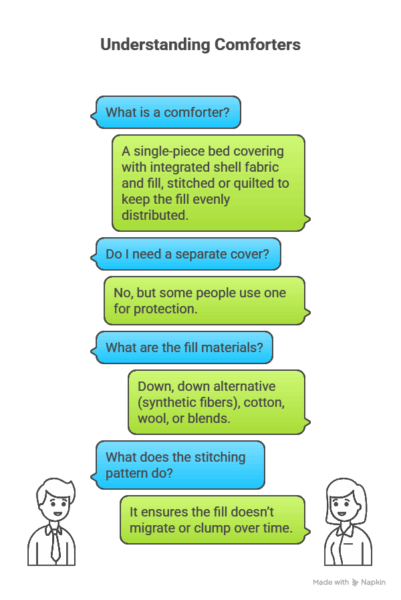
A comforter is a single-piece bed covering with integrated shell fabric and fill, stitched or quilted to keep the fill evenly distributed. You don’t need a separate cover (though some people use one for protection). In many markets, comforters come in a wide variety of colors, patterns, and textures so they can act as the bedding’s visual focal point.
Fill materials: Down, down alternative (synthetic fibers), cotton, wool, or blends. The stitching pattern (box, baffle, channel) ensures fill doesn’t migrate or clump over time.
Strengths & Limitations
Pros:
- Simplicity: no need to fuss with an insert + cover; just grab and place.
- Many style options—colorful, patterned, textured—so you can coordinate the look of a room.
- Often more affordable upfront (since you aren’t buying a separate insert + cover).
- For some users, it’s a one-and-done solution.
Cons:
- Because the fabric shell is also the outer surface, the entire comforter must be laundered when dirty—not just a cover.
- Many home washers/dryers aren’t large enough for bulky comforters—commercial laundry or professional cleaning might be required.
- Over time, fill may settle, lose loft, or develop cold spots.
- Changing the aesthetic means replacing the whole comforter, not just a cover.
- In humid climates, thick comforters may feel too warm or heavy.
Hospitality / Wholesale Considerations for Comforters
- Durability and resistance to frequent washing should be a top priority.
- Select fabrics and fills with stain resistance, antimicrobial treatment, or moisture-wicking properties.
- Ensure stitching and quilting are robust to avoid seams ripping under heavy use.
- Offer color options/patterns that align with interior design, but be cautious about overly decorative styles (they may date or limit flexibility).
Duvet vs Comforter: What Makes Them Different?
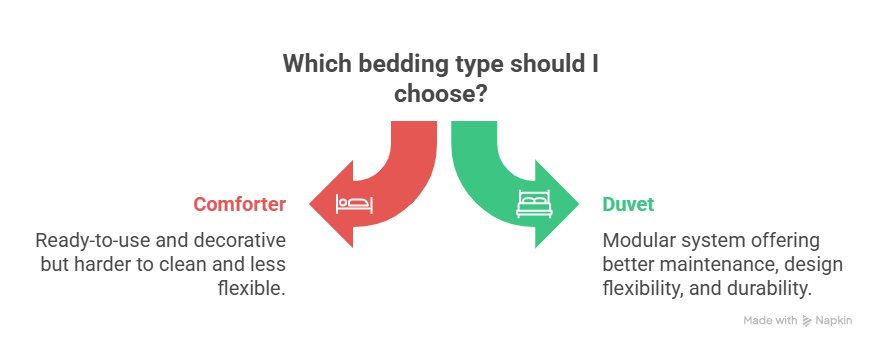
Though many people use “duvet” and “comforter” interchangeably, here’s the practical distinction:
- A comforter is a single piece: shell + fill already integrated (ready to use).
- A duvet insert + cover is a modular system: you combine the insert and cover into one unit.
- Because of this modularity, duvets offer better maintenance, design flexibility, and often longer durability (thanks to the cover protecting the insert)
- Comforters tend to be more decorative and ready-to-go, but at the cost of harder cleaning and less flexibility.
What Is a Quilt?

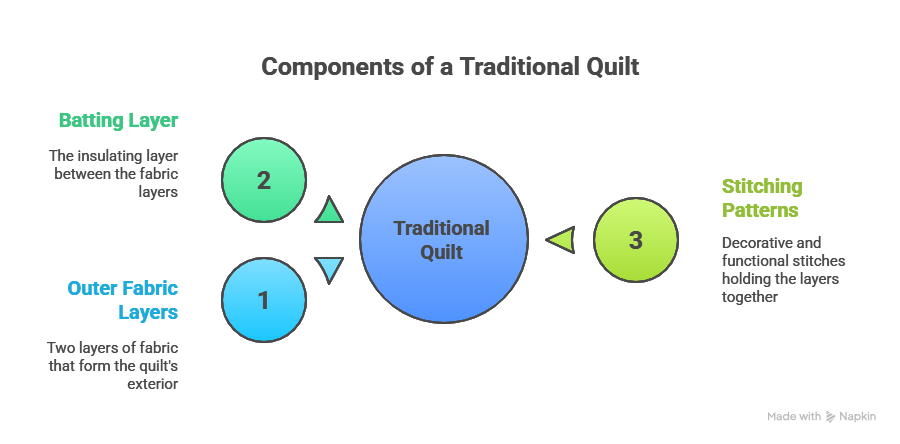
A quilt is traditionally a three-layered bedding piece: two outer fabric layers sandwiching a layer of batting (insulation) in the middle. The layers are stitched or “quilted” together in patterns (squares, motifs, continuous lines) to hold the batting in place. Because the fill is generally lighter or thinner than that in comforters or duvets, quilts tend to be flatter in profile.
Some common types:
- Wholecloth quilts: Use a single fabric piece for the top layer (no patchwork).
- Patchwork quilts: Combine many fabric pieces to create designs or motifs.
- Reversible quilts: Both sides may be decorative or usable, giving you design flexibility.
Materials: Cotton (for shell and backing), cotton batting, poly batting, wool, or a blend. The choice of batting affects warmth, weight, and washability.
Strengths & Limitations
Pros:
- Because quilts are lighter and thinner, they often breathe better and are more comfortable in warmer weather or climates.
- No need for an additional cover (you see the design directly).
- Quilts can double as decorative throws or summer covers.
- Reversible designs give you flexibility in look without a separate cover.
Cons:
- Because quilts are lighter, they may not provide sufficient warmth in colder conditions.
- In a hotel / rental setting, frequent laundering can strain the stitching or fabric.
- Some quilts, especially handcrafted or heirloom ones, demand special care.
- They may flatten over time or lose loft.
When Quilts Make Sense (Especially in Hospitality)
- In hot / humid climates (e.g. tro`pical regions, summer months), quilts can offer a lighter covering that feels comfortable and not stifling.
- As layering pieces—for example, pairing a quilt with a lightweight duvet insert in transitional seasons.
- As decorative / accent covers in guest rooms, giving a cozy, homey look without bulk.
- In settings with budget constraints or where laundering capacity is limited, simpler, lighter quilts may reduce stress on washes.
Choosing for Guest Bedding / Bulk / Wholesale Use
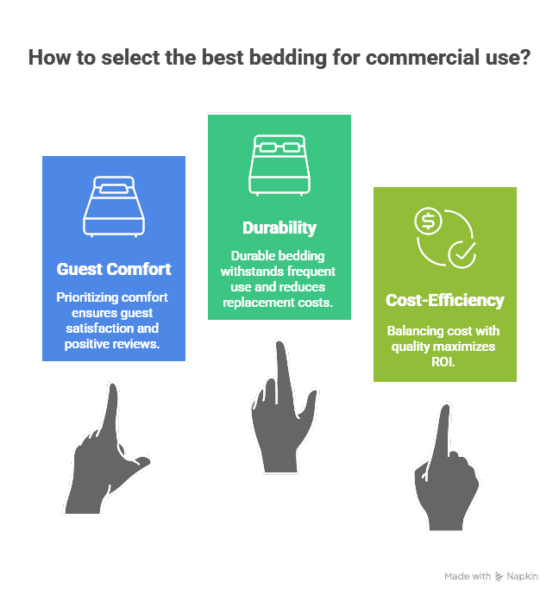
When selecting bedding for hotels, resorts, or vacation rentals, your priorities differ from those of a home buyer. The right choice should balance guest comfort, durability, and cost-efficiency. Here’s what to consider:
1. Durability Under Frequent Use
Opt for bedding crafted with reinforced seams, double-stitched borders, and down-proof shells that withstand repeated laundering and daily use. Industrial-quality fabrics ensure long-lasting performance without losing their plush feel.
2. Replaceability and Modular Design
Duvets offer a smart advantage, you can replace the cover instead of the entire insert, reducing long-term costs and simplifying upkeep. This flexibility makes them ideal for high-turnover environments.
3. Weight & Ease for Housekeeping
Lightweight quilts or duvet inserts make bed-making faster and easier for staff, while bulky comforters can slow room turnover. Select options that balance warmth with manageable weight.
4. Stain Resistance & Hygiene
Prioritize bedding with stain-resistant finishes, antimicrobial treatments, or high-thread-count shells to protect against spills, odors, and allergens, ensuring a consistently fresh guest experience.
5. Standardized Sizing
Use standard hotel dimensions across all quilts, covers, and inserts. This simplifies inventory management, reduces confusion, and keeps your rooms looking uniform.
6. Cost per Use & ROI
Over time, a duvet system with replaceable covers often proves more economical than replacing full comforters.
FAQs
- Can I use a comforter inside a duvet cover?
Yes, often they are similarly sized. But make sure there are anchoring loops / ties so the comforter doesn’t shift inside. - Which is better — down or down alternative fill?
Down offers an excellent insulation-to-weight ratio but may cause allergies and require more care. Down alternatives are hypoallergenic and easier to clean. - How often should I replace a duvet/quilt /comforter?
With good care, inserts and quilts can last many years—but evaluate based on loft loss, thinning, stains, or structural damage. - Will duvet inserts shift inside covers?
It can happen. Look for corner ties, inside loops, or channel baffles to secure alignment. - Which is better for humid climates?
Lightweight quilts or lighter duvet inserts (or even summer-specific inserts) are best to avoid overheating. Breathable shells help. - Can I wash large duvet inserts at home?
Only if your machines are large enough (e.g. 10 kg+ capacity). Otherwise, use commercial laundry or professional cleaning.
Conclusion
When selecting bedding for hospitality properties, the choice between a duvet, comforter, or quilt goes beyond simple aesthetics. It’s a strategic decision that impacts guest comfort, operational efficiency, and long-term costs.
While comforters and quilts offer simplicity and distinct styles, the duvet system often emerges as the most practical and cost-effective choice for high-turnover environments. Its modular design, featuring a removable cover, simplifies laundry cycles, extends the life of the insert, and provides unparalleled flexibility for updating room aesthetics. This makes the duvet a durable, hygienic, and financially sound investment.
Ultimately, the right choice for your property will depend on your specific needs, climate, and budget. By carefully considering the pros and cons of each, you can select bedding that not only ensures a great night’s sleep for your guests but also streamlines your operations and protects your bottom line.