

How do you calculate and convert wholesale towel GSM and pounds per dozen?
To calculate GSM, use this formula:
GSM = Weight of 1 Towel in Grams / (Length in Meters X Width in Meters)
To convert pounds per dozen (lbs/dz) to GSM for a given towel size in inches:
GSM = (lbs/dz X 453.592) / (Width (in) X Length (in) X 12 X 0.00064516)
Custom Sourcing Metrics Matched to DZEE USA Brand Guidelines
Table of Contents
Key Takeaways
- Verify fabric specifications using precise conversion math rather than relying on total batch shipping weights.
- Balance luxury and utility by selecting a fabric weight that matches your property tier and laundry budget.
- Inspect fabric construction details like yarn style and base warp strength instead of evaluating towels on weight alone.
- Use systematic testing protocols with a calibrated scale and sample cutter to audit incoming textile shipments.
- Prepare for industry updates by choosing eco-certified products and tracking inventory life spans with RFID systems.
Procurement managers face tight budgets and high guest expectations when buying commercial textiles. Evaluating bulk towel inventory based on vague product descriptions often leads to costly purchasing mistakes. Financial success in hospitality operations relies heavily on selecting assets that survive industrial laundering while maintaining performance.
Understanding fabric weight metrics protects your property from early textile degradation and guest complaints. This technical guide explains how to use a GSM calculator to verify wholesale fabric specifications accurately. You will learn how to convert pounds per dozen to grams per square meter seamlessly. We will cover technical textile standards, precise calculation formulas, and structural cost-benefit analyses.
Understanding Towel Fabric Metrics in Wholesale Procurement
Wholesale textile procurement requires a deep understanding of fabric weight measurements to ensure consistent product performance. In the global commercial laundry and hospitality ecosystems, teams measure fabric density using two primary metrics.
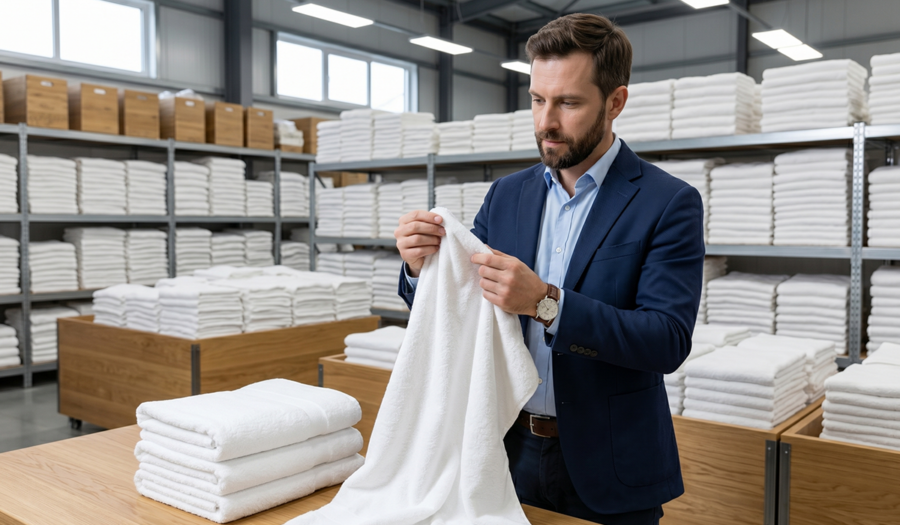
The first metric is GSM (Grams per Square Meter), which serves as the international standard for fabric weight analysis. It isolates fabric density from the physical dimensions of the finished product.
The second metric is pounds per dozen lbs/dz, which is widely used in North American commercial trade. This number represents the total weight of 12 identical finished towels.
What is GSM?
GSM is a specific metric that determines the mass of a fabric independent of product dimensions. In terry towel manufacturing, GSM directly correlates with the pile height, loop density, and structural integrity of the yarn.
High GSM fabric features dense, closely packed loops that create a heavy yarn weight per square meter. Low GSM fabric features sparser loops, resulting in a lighter weight and thinner material profile.
Why Weight Metrics Matter for Your Bottom Line
Fabric weight metrics dictate product lifecycle durability, guest satisfaction scores, and ongoing utility costs. A high pile weight increases moisture retention capacity, which enhances the guest experience. However, heavy fabrics require longer drying cycles in industrial laundry facilities.
Procurement teams use a GSM calculator for fabric to verify that their towels match specifications across varying production batches. This verification step ensures that your guest rooms offer consistent quality.
The Structural Challenges of Bulk Textile Evaluation
Corporate buyers struggle to compare different wholesale towel options when suppliers use inconsistent measurement systems. A manufacturer overseas might list a bath towel at 600 GSM. Meanwhile, a local domestic distributor might describe the same product as 15 lbs/dz.
Without a clear way to convert these numbers, buying committees cannot easily calculate the actual value or ROI. This confusion makes it difficult to establish objective quality benchmarks for purchasing.
The Procurement Blind Spot
- Overseas Factory Specification: 600 GSM
- Domestic Distributor Offer: 15 Lbs/DozenWithout precise conversion formulas, corporate buyers cannot easily compare actual material density or value.
The Limits of Pounds Per Dozen
The lbs/dz metric tells you the total weight of a shipment, but it hides structural details. For example, a large pool towel and a compact bath mat can both weigh 15 lbs/dz.
The pool towel will feel thin because its weight is spread across a large surface area. The bath mat will feel thick and dense because its weight is concentrated in a smaller footprint. Relying solely on total weight can mislead buyers regarding fabric thickness and absorbency.
How Structural Variations Impact Performance
Yarn manufacturing methods change fabric performance, even when the overall GSM remains identical. Ring-spun cotton tightly twists long fiber strands together to produce a smooth, strong, and durable yarn surface.
Combed cotton undergoes an extra manufacturing step to remove short fibers and impurities before spinning. This process improves fabric softness and reduces linting during initial industrial wash cycles.
Yarn Manufacturing Differences (Same Weight, Different Performance):
- Ring Spun Cotton: Long, twisted fibers lead to high tensile strength and durability.
- Combed Cotton: De-linted, aligned fibers provide superior softness and low lint shedding.
How to Convert Metrics Using the Towel GSM Calculator Formula
Verifying fabric specifications requires precise math rather than rough estimates. To learn how to calculate GSM of fabric, you must master conversions between metric and imperial systems.
The weight of a towel depends on its total surface area. You must convert dimensions into square meters before calculating fabric density.
Conversion Architecture:
- Dimensions: [Inches x Inches] converted to Square Meters equals the Surface Area.
- Mass: [Pounds per Dozen] converted to Grams per Unit equals the Single Mass.
- Result: Divide the single mass by the surface area to find the exact GSM.
The Step-by-Step Towel GSM Calculation Formula
To calculate fabric weight per square meter manually, you must determine the single-unit weight in grams. Next, calculate the single-unit surface area in square meters. Use these basic steps:
- Convert length and width from inches to centimeters by multiplying by 2.54.
- Divide the centimeter dimensions by 100 to get the length and width in meters.
- Multiply the length in meters by the width in meters to find the total area in square meters.
- Convert the single towel weight from pounds to grams by multiplying by 453.592.
- Divide the gram weight by the square meter area to calculate the final GSM.
The Step-by-Step Hotel Towel GSM Calculation Formula
When working with wholesale dimensions, use this exact formula to convert fabric weight per square meter from pounds per dozen:
Let us review a real-world example using a standard mid-range bath towel. The product specifications list dimensions of 27 X 54 inches and a weight of 14 lbs/dz.
- Step 1: Calculate total square inches: 27 X 54 X 12 towels = 17,496 sq in.
- Step 2: Convert total square inches to square meters: 17,496 X 0.00064516 = 11.288 sqm.
- Step 3: Convert total dozen weight to grams: 14 X 453.592 = 6,350.288 grams.
- Step 4: Divide total grams by total square meters: 6,350.288 / 11.288 = 562.57 GSM.
Our formula shows that this specific 14 lbs/dz product has a fabric density of 563 GSM.
Cost Analysis: Balancing Plushness Against Commercial Laundry Overhead
Hospitality executives must balance the luxury of a high GSM vs. a low GSM fabric against its operational costs. Heavy towels please guests, but increase utility bills in commercial laundry facilities.

A 400 GSM towel washes and dries much faster than a thick 650 GSM luxury bath towel. This faster cycle time reduces water, chemical, and energy usage per laundry load.
The Cooperative Cost Tradeoff:
- Low GSM (300-400): Features low procurement costs and rapid drying cycles, which decrease utility bills.
- High GSM (600+): Features higher capital costs and long drying cycles but delivers a premium experience.
Selection Strategy: Match fabric density directly to your specific property tier.
Commercial Operational Cost Matrix
The table below shows how different fabric weight ranges perform across key operational metrics. It highlights the direct trade-off between guest comfort and laundry expenses.
| Property Tier / Application | Target GSM Range | Target Lbs/Dozen (Bath Size) | Absorbency Rating | Average Drying Cycle Time | Relative Operational Cost |
|---|---|---|---|---|---|
| Economy Motels / Gyms | 300 – 400 | 8.0 – 10.5 | Moderate | Fast 25 – 35 mins | Low |
| Midscale Hotels / Resorts | 450 – 550 | 11.0 – 15.0 | High | Standard 40 – 50 mins | Medium |
| Luxury Hotels / Spas | 600 – 800 | 17.0 – 22.0 | Maximum | Extended 60 – 75 mins | High |
Formulating the Internal Business Case
When presenting textile capital requests to a chief financial officer, emphasize the total cost of ownership rather than just the initial price. Premium towels cost more upfront but often feature stronger selvage edges and sturdier ground warps.
These structural reinforcements prevent unravelling and withstand more industrial wash cycles before thinning out. Investing in higher-quality fabric reduces how often you need to replace your inventory, which lowers long-term procurement costs.
Common Procurement Mistakes and How Procurement Teams Avoid Them
Inexperienced buyers often make costly purchasing mistakes by focusing solely on weight without verifying the underlying fabric construction. A heavy towel is not automatically a durable towel.
If a manufacturer uses low-grade short fibers, the towel will shed heavily in the dryer. This shedding causes the fabric to lose density and thin out after only a few weeks of commercial laundering.
Procurement Pitfall Path: Heavy Total Weight + low-grade short fibers → High shedding → Rapid loss of GSM density in the laundry.
Mistake 1: Ignoring Ground Warp Yarn Count Calculation
A towel consists of pile loops and an underlying base fabric called the ground warp. Some manufacturers save money by weaving heavy pile loops into a weak, low-density base fabric. During commercial laundering, the weak base can shrink or tear while the pile loops remain intact. Always check the warp and weft analysis to confirm the base fabric is strong enough to support the loops.
Mistake 2: Failing to Account for Border Shrinkage
Decorative dobby borders often shrink at a different rate than the main cotton terry body. This unequal shrinkage causes the edges to pull and warp, distorting the towel’s shape. To prevent this distortion on guest room racks, specify pre-shrunk polyester-dobby borders when ordering bulk inventory.
Supplier Evaluation Checklist
Give this specific technical checklist to your textile suppliers during the bidding process to protect your investment:
- Request the exact GSM formula for towels used to verify production consistency.
- Confirm the yarn count details for both the pile loops and the ground warp base.
- Verify the fiber content blend percentages (e.g., 100 ring spun cotton versus an 86/14 poly-blend base).
- Ask for official documentation showing shrink resistance performance after 50 commercial wash cycles.
A Step-by-Step Textile Quality Control Inspection Workflow
Do not rely entirely on factory specification sheets. When sample shipments arrive, your quality control team should follow a standardized inspection process to verify the fabric weight.
Quality Control Testing Pipeline: Environmental Conditioning → Precision Cutting via GSM cutter → Mass Measurement via digital scale → Cross-referencing results.
The Factory Inspection Protocol:
- Environmental Conditioning: Place fabric samples in a room with 65% relative humidity at 21°C (70°F) for 24 hours to stabilize moisture levels before testing.
- Precision Sample Cutting: Use a standardized GSM fabric cutter to punch out precise circular fabric samples measuring exactly 100 square centimeters.
- Digital Mass Measurement: Weigh the cut circle on a calibrated digital weighing scale that measures accurately down to 0.01 grams.
- Final Value Calculation: Multiply the resulting gram measurement by 100 to determine the exact fabric weight per square meter.
Advanced Quality Laboratory Testing Metrics
Large commercial operations often run fabric samples through formal textile lab testing to verify international quality standards. These laboratory tests evaluate performance across several key areas:
- Fabric Density Measurement: Automated analysis determines thread count, loop density, and structural consistency across the fabric surface.
- Absorbency Testing: Lab tests measure how long it takes the fabric to absorb water drops and calculate its total moisture retention capacity under pressure.
- ISO Textile Testing Standards: Tests verify compliance with international standards like ISO 3801, which regulates the measurement of woven fabric mass per unit area.
The Core Product Solutions: Strategic Wholesale Textile Matches
Matching specific product lines to your property type ensures optimal performance and guest satisfaction. Below are five high-performing commercial textile solutions tailored for different business needs.
1. Opal Super Blend Plus Full Terry Towels
- Ideal for: High-turnover institutional laundry environments.
- Core Benefit: Polycotton blend resists tearing and minimizes drying times to lower your property’s utility costs.
- Textile Construction Details: Features a durable polycotton blended base frame wrapped in soft, absorbent full-terry loop piles.
- Procurement Fit: Excellent for high-volume midscale motels, gym facilities, and busy athletic clubs.
2. Mikado Towel Collection
Midscale hotels require an optimal balance of premium guest comfort and long-term product durability. The Mikado collection provides a soft, plush feel while withstanding frequent industrial laundering without fraying.
- Textile Construction Details: Made from 100% combed cotton yarns with double-stitched side hems to prevent unravelling.
- Procurement Fit: Perfect for regional hotel chains, corporate select-service properties, and busy conference center resorts.
3. Ryotei Luxury Towel Collection
Boutique hotels and high-end properties need dense, absorbent bath linens that feel substantial and luxurious to guests. The Ryotei collection features a high pile weight that delivers excellent absorbency and a premium presentation on guest room racks.
- Textile Construction Details: Woven with premium long-staple ring-spun cotton loops attached to a dense, shrink-resistant ground warp base.
- Procurement Fit: Ideal for independent boutique properties, upscale urban hotels, and modern luxury retreats.
4. Forte Luxury Towel Line
High-end commercial venues require executive-tier textiles that maintain their soft texture and vibrant color over months of heavy use. The Forte line provides excellent tensile strength and resists thinning out after repeated commercial wash cycles.
- Textile Construction Details: Crafted using long-staple combed cotton loops linked together with a reinforced low-shrinkage dobby border system.
- Procurement Fit: Designed for premium corporate lodging, executive club lounges, and upscale spa facilities.
5. Belem 2-Ply Exclusive Collection
- Ideal for: Five-star luxury resorts, premium spas, and elite suites.
- Core Benefit: Maximum fabric weight provides a plush feel and peak absorbency for an exceptional guest experience.
- Textile Construction Details: Heavyweight, high-GSM design made from long-staple ring-spun yarns and finished with elegant decorative details.
- Procurement Fit: Perfect for five-star luxury resorts, premium day spas, and elite hospitality suites.
Future Trends: Eco-Certifications and Smart Commercial Laundries
Modern textile procurement requires keeping an eye on changing environmental regulations and new laundry technologies. Global supply chains are shifting toward sustainable manufacturing methods and traceable materials. Properties must adapt to these trends to remain competitive and meet corporate sustainability goals.
The Rise of Eco-Certifications
Corporate clients increasingly demand proof of environmentally friendly operations when booking events and lodging. Meeting these standards requires sourcing textiles with verified eco-certifications. The OEKO-TEX Standard 100 certification confirms that your towels are free from harmful levels of toxic chemicals and heavy metals.
High-Tech RFID Tracking Systems
Commercial laundry facilities are increasingly embedding small RFID (Radio Frequency Identification) microchips directly into towel hems. These water-resistant chips track exactly how many times each item goes through a wash cycle. This data helps procurement managers monitor fabric life spans and predict when inventory will need replacement.
DZEE Textiles: No.1 Source Of Hotel Supplies in the US
DZEE Textiles is your one-stop shop for all wholesale hotel supplies, serving more than 10,000 customers in the United States. As a wholesale supplier of high-quality hotel supplies, we offer top-notch towels, bed linens, decorative bedding, hotel accessories, electrical appliances, cleaning supplies, and other hospitality items at wholesale prices, with free shipping on most orders. With over 25 years of experience and distribution centers in Orlando, FL; Knoxville, TN; Dallas, TX; and Las Vegas, NV, we ensure quick distribution and unmatched service across the USA.
Frequently Asked Questions
How do I convert pounds per dozen to GSM if I do not have a digital towel GSM calculator tool?
You can convert the metrics manually using basic arithmetic. First, multiply the total pounds per dozen by 453.592 to convert the weight into grams. Next, calculate the single towel surface area by multiplying the width by the length in inches, then multiplying by 12, and finally multiplying by 0.00064516 to get square meters. Divide the total grams by the total square meters to find the exact GSM value.
Why does a 500 GSM towel from one supplier feel softer than a 500 GSM towel from a competitor?
Fabric softness depends on the quality of the yarn and manufacturing processes rather than weight alone. A towel made from combed or ring-spun cotton feels softer than one made from cheaper open-end carded yarns, even if they have the exact same GSM. Variations in loop height and density also change how soft and plush the fabric feels against the skin.
What is the ideal towel GSM range for high-volume beach and pool operations?
For outdoor resort environments, target a mid-range fabric density between 400 and 500 GSM. This range provides a good balance of absorbency for guests while drying quickly on outdoor racks or in commercial dryers. Choosing a fabric weight within this range helps control energy costs during heavy summer use.
How does the choice of yarn count impact the structural lifespan of commercial hotel towels?
Yarn count measures the fineness or thickness of the cotton threads used to weave the fabric. Lower numbers represent thicker, heavier threads that provide excellent structural strength and resist tearing in industrial washing machines. Higher yarn counts use finer, thinner threads that offer superior softness but require careful handling to prevent premature fraying.
Can our property use residential washing setups for high-GSM luxury towels?
Residential washing machines lack the water volume, extraction force, and temperature controls needed to clean dense commercial textiles. Heavy towels trap oils and soils deep within their dense loops, requiring industrial wash formulas to clean thoroughly. Processing luxury commercial towels in residential equipment leads to graying fabric, unpleasant odors, and rapid wear.
Does DZEE Textiles offer custom color options and brand embroidery for bulk institutional orders?
Yes, our manufacturing facilities provide custom yarn dyeing and specialized brand embroidery for high-volume hospitality orders. Properties can find tailored textile lines, like the Belem Exclusive Collection, configured to match their brand standards. Contact our B2B procurement team directly through our website to review minimum order volumes and custom production timelines.
Final Words
Sourcing commercial textiles requires a deep understanding of fabric performance metrics and operational costs. Mastering the use of a GSM calculator allows procurement teams to protect their investments and maintain consistent room standards. Verifying fabric weights helps you select durable linens that withstand the rigors of industrial laundering.
Are you looking to optimize your property’s linen inventory and improve cost-efficiency? Contact the commercial textile experts at DZEE Textiles today. Our team will analyze your laundry workflows and provide tailored product recommendations to help you get the most out of your textile budget.


