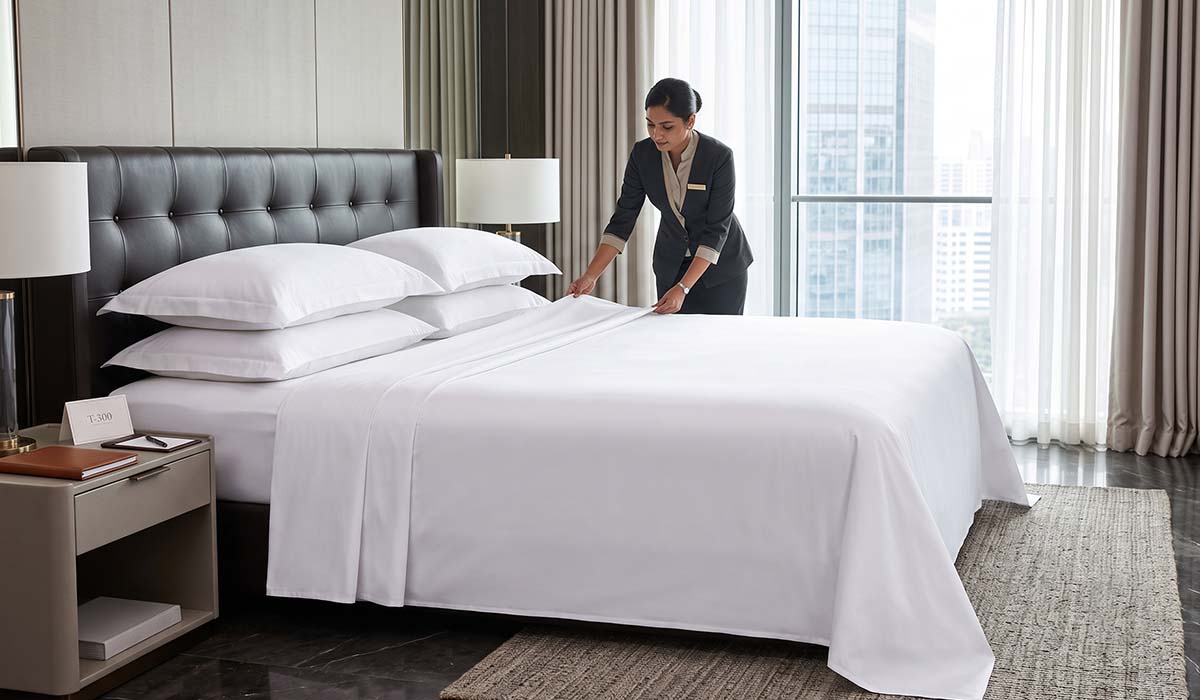
To choose the right cotton sheets for resorts, balance guest luxury with industrial durability. Select 100% combed long-staple cotton or a T-200 to T-3250 poly-cotton blend sheets. Prioritize percale or sateen weaves engineered for high tensile strength. Ensure deep pockets with institutional elastic and crease-resistant finishes to withstand 150+ commercial wash cycles.
Resort operations managers must balance guest demand for luxurious, breathable bedding with tight replacement budgets. Daily commercial laundering exposes linens to aggressive chemicals, extreme heat, and heavy friction. Selecting unsuitable cotton sheets causes rapid fraying, shrinkage, and costly premature replacements.
This comprehensive guide explains in detail how to choose commercial linen for resorts. You will learn how to evaluate fibers, weaves, thread counts, and structural treatments to optimize guest comfort and operational ROI.
Table of Contents
Why Commercial Bedding Demands a Specialized Strategy
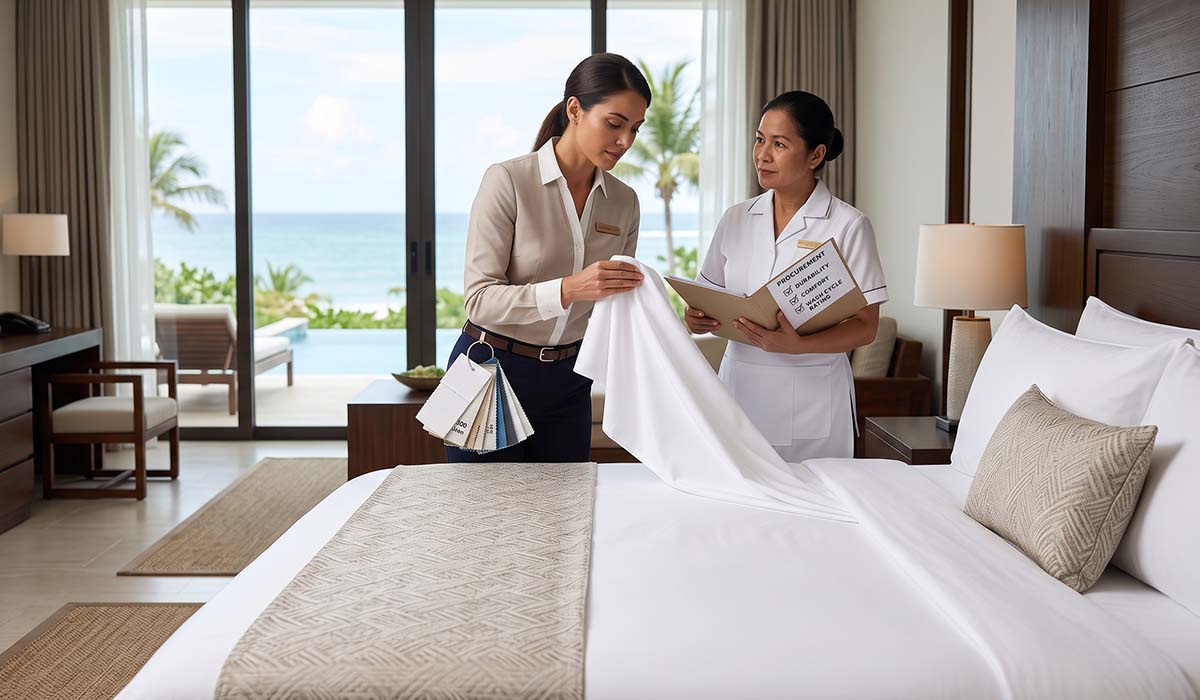
Why do consumer retail sheets fail so quickly in a resort environment?
Retail sheets focus on out-of-the-box softness. Commercial linens prioritize tensile strength, seam integrity, and color retention under heavy industrial processing.
The commercial bedding operational cycle follows a demanding loop:
- Guest Room Usage
- High-Speed Room Turnaround Cleaning
- Industrial Wash (160°F+ Water and Bleach)
- High-Heat Ironing and Pressing
- Harsh commercial Drying Cycles
When resorts buy retail-grade linens, replacement rates surge within six months. Household linens cannot withstand commercial laundries’ high-temperature wash cycles and chemical processing.
Procurement teams must evaluate bedding as a multi-year operational asset. Every wash cycle costs labor, energy, and material degradation. Selecting specialized institutional bedding reduces replacement frequency, directly protecting bottom-line profitability.
Beyond durability, guest satisfaction directly ties to online reviews and property revenue. A single complaint about stiff or worn sheets damages your resort’s reputation. Commercial procurement must strike a precise balance between soft tactile comfort and rugged structural durability.
Understanding raw material composition is the critical first step in achieving this balance.
The Commercial Fiber Breakdown: 100% Cotton Sheets vs. Poly-Cotton Blend Sheets
Are 100% cotton sheets always superior to synthetic blends for commercial resort applications? The answer depends on your property’s laundry infrastructure, target guest tier, and climate.
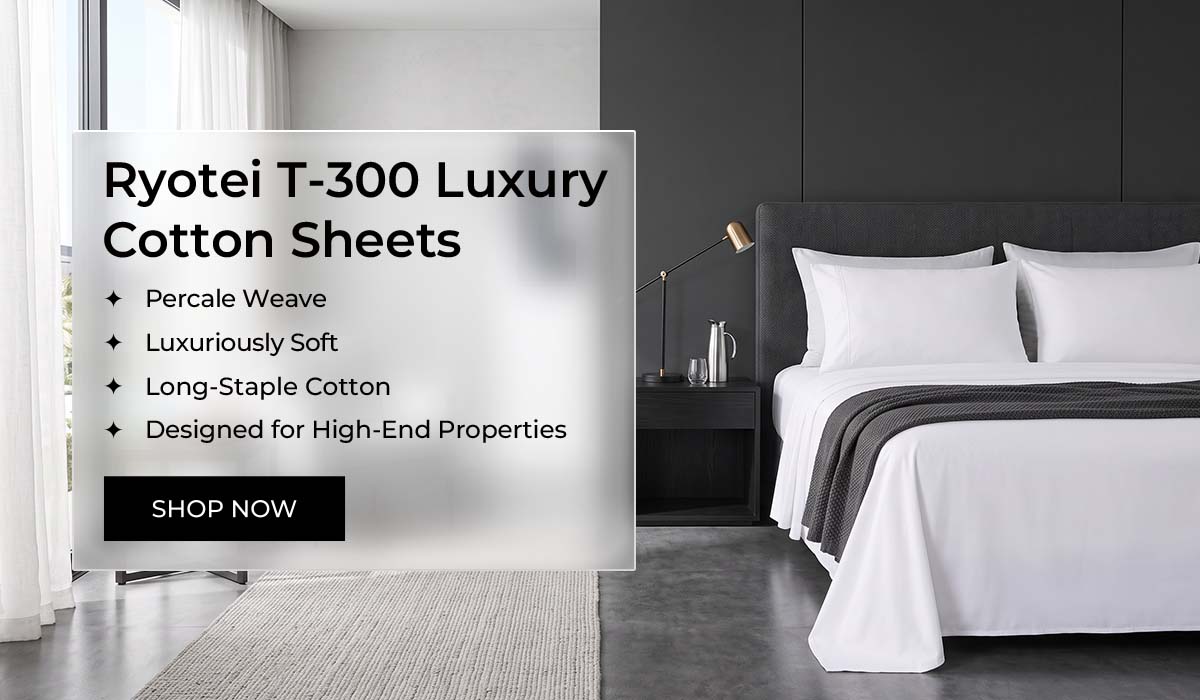
- 100% Cotton Bed Sheets: Offer unmatched breathability, natural softness, and a luxury feel. Long-staple cotton, such as DZEE’s Ryotei T-300 Luxury Cotton Sheets, creates smooth, strong yarns that resist pilling. However, 100% cotton absorbs more water, increases drying times, wrinkles easily, and exhibits higher initial shrinkage.
- Cotton Blend Sheets (60% Cotton / 40% Polyester or 70/30): Combine the natural comfort of cotton with the tensile strength and quick-drying properties of polyester. They wrinkle less, dry up to 30% faster, and withstand harsh laundry chemicals better than pure cotton.
Choosing between pure cotton and a blend establishes your baseline performance. Next, you must consider the weave, thread count, and physical dimensions.
Structural Integrity: Weave, Thread Count, and Pocket Depth
Does a higher thread count always guarantee a better sheet for commercial hospitality environments?
In retail marketing, thread count, the number of horizontal (weft) and vertical (warp) threads per square inch, is often overhyped.
In commercial hospitality, inflated thread counts made with cheap multi-ply yarns create heavy, non-breathable fabrics that tear easily in industrial washers.
- Optimal Thread Count Range: For resorts, T-200 to T-300 represents the sweet spot. A T-200 sheet provides durability and airflow for high-turnover properties. A T-250 to T-300 sheet delivers a luxurious feel without trapping heat or overloading commercial washers.
- Percale Weave: Features a plain, one-over-one-under grid structure. Percale sheets are crisp, cool, highly durable, and resist pilling. They are ideal for warm climates and high-humidity beach resorts.
- Sateen Weave: Uses a four-over-one-under weave pattern that exposes more yarn surfaces, creating a subtle sheen and silky drape. Sateen feels softer against the skin but exhibits slightly lower tear strength than percale when exposed to industrial ironers.
- Pocket Depth and Fit: Modern luxury resort mattresses feature thick pillow-tops or mattress pads, often measuring 14 to 18 inches deep. Standard 12-inch sheet pockets slip off during the night, leading to guest complaints. Specify deep-pocket fitted sheets (16 to 18 inches) with heavy-duty, fully encased elastic borders to ensure a snug, clean fit.
Fabric geometry defines how a sheet feels and fits. Chemical and mechanical processing determines how long that fabric lasts under operational stress.
Industrial Laundering, Shrinkage, and Treatments of Cotton Sheets in Resorts
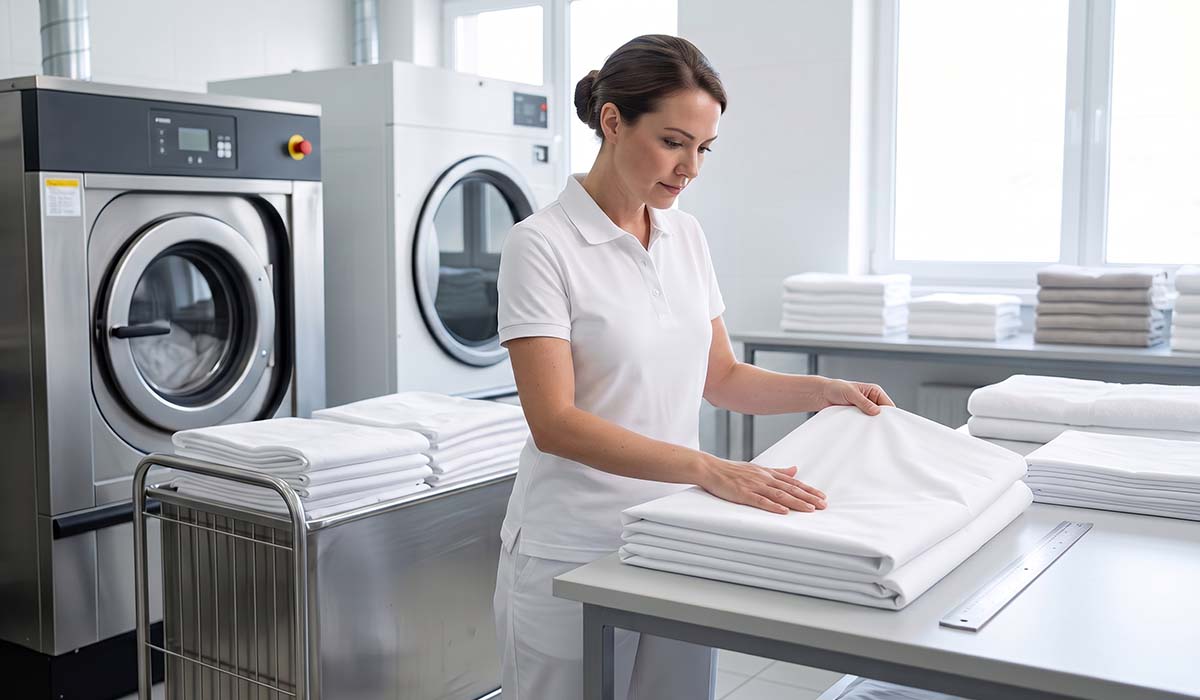
How do laundry chemicals and high-heat drying ruin commercial sheets before their time?
Industrial laundries process linens using high-alkali detergents, chlorine or oxygen bleach, and wash temperatures exceeding 160°F (71°C). Standard retail cotton degrades rapidly under these aggressive chemical conditions.
- Industrial Laundering Durability: Commercial-grade sheets use combed cotton yarns. This mechanical combing process removes short, weak fibers, leaving only long, aligned strands that resist fraying and pilling. Single-ply yarns yield significantly higher tensile strength than cheap double-ply twisted yarns.
- Shrinkage Tolerance: Natural cotton fibers contract when exposed to moisture and heat. Quality commercial manufacturers preshrink fabrics to keep residual shrinkage under 3% to 5%. Unprocessed retail sheets can shrink up to 10% to 12%, rendering them unusable after a few washes.
Learn More: Why Do Top Resorts Choose Horizontal Stripe Pool Towels?
- Specialized Fabric Treatments:
Antimicrobial Finishes: Prevent bacterial growth, odor retention, and fabric degradation in humid resort settings.
Stain-Release Finishes: Allow oils, lotions, and organic stains to wash out easily at lower water temperatures, saving energy.
Color Retention and Brightness: Bright white remains the universal standard for luxury resorts. Vat-dyeing processes or specialized optical brighteners prevent yellowing and keep sheets looking crisp through dozens of washings.
Recommended Features for Resort Bed Sheets
- Fiber Content: 100% Long-Staple Combed Cotton or 60/40 Blend
- Thread Count: T-200 (Economy) to T-300 (Luxury)
- Weave Construction: Crisp Percale or Smooth Sateen
- Residual Shrinkage: Under 3% to 5% maximum
- Pocket Depth: 16 to 18 inches (Heavy-duty fully encased elastic)
- Hem Styling: 2″ to 4″ clean-stitched top hem
Commercial Bed Sheet Comparison
When evaluating commercial sheet options, comparing physical properties side by side clarifies trade-offs in durability, maintenance, and guest satisfaction.
| Specification Criteria | T-200 Poly-Cotton Blend | T-300 Premium Cotton Sateen |
| Best Suited For | High-turnover motel/resort rooms | High-end boutique & suite properties |
| Tactile Feel | Crisp, clean, smooth | Silky, heavy drape, lustrous |
| Tensile Strength | Exceptional (Polyester reinforcement) | Moderate-High (Long-staple yarn) |
| Laundry Processing | Dries 30% faster; low ironing | Standard dry times; precise pressing |
| Estimated Lifecycle | 150 – 200+ wash cycles | 100 – 130 wash cycles |
| Cost Per Unit | Highly cost-effective | Premium capital investment |
Learn More: Highest Quality Comforters for Hotels and Resorts
How to Measure Bedding ROI and Replacement Lifecycles
How do you build a convincing business case to prove that buying higher-quality commercial bed sheets lowers total operating costs?
Procurement decisions should never rely solely on the initial purchase price. You must calculate the Cost Per Use (CPU) across the product’s full working lifespan.
Cost Per Use Formula
Cost Per Use = (Initial Purchase Price + Lifetime Laundering Cost) / Total Usable Wash Cycles
Example Comparison:
- Option A (Retail Sheet): $15 Purchase Price divided by 50 Wash Cycles = $0.30 per guest stay
- Option B (Commercial Bedding): $25 Purchase Price divided by 200 Wash Cycles = $0.125 per guest stay
A commercial sheet costs $10 more upfront than a retail option. However, because it lasts four times longer in industrial laundries, the commercial sheet reduces your per-stay cost by over 58%.
Track par levels carefully to maximize sheet lifespan. Operating on a 3-par system (one set on the bed, one in the linen closet, and one in the laundry process) allows cotton fibers to rest and recover moisture balance between uses. This rotation schedule significantly extends fabric life.
Learn More: What is The Best Fabric For Commercial Hotel Bedding?
How DZEE Textiles Upgrades Resort Bedding Procurement
DZEE Textiles is your one-stop shop for all hotel supplies, serving more than 10,000 customers in the United States.
As a wholesale supplier of high-quality hotel supplies, we offer top-notch towels, bed linens, decorative bedding, hotel accessories, electrical appliances, cleaning supplies, and other hospitality items at wholesale prices, with free shipping on most orders.
With over 25 years of experience and distribution centers in Orlando, FL; Knoxville, TN; Dallas, TX; and Las Vegas, NV, we ensure quick distribution and unmatched service across the USA.
Selecting commercial bedding requires a supplier that understands the demanding realities of resort operations. DZEE Textiles provides engineered hospitality solutions designed for maximum durability and guest comfort.
- Institutional Fabric Engineering: Long-staple yarns, crease resistance, and institutional dyes that hold up to repeated bleach cycles.
- Precision Seam Integrity: Reinforced hems, preshrunk fabrics, and continuous heavy-duty elastic.
- High-Volume Stock Distribution: Fast nationwide shipping and direct bulk B2B pricing.
Explore our complete catalog of commercial bed sheets to upgrade your property’s linen inventory today.
Future Trends in Resort Linen Procurement
What upcoming innovations will reshape commercial hospitality textiles over the next decade?
- Traceable Sustainable Cotton: Resorts are increasingly turning to certified organic or Recycled Claim Standard (RCS) cotton. Blockchain-based tracking allows hotel brands to verify fair-labor and eco-friendly sourcing for eco-conscious travelers.
- Smart Micro-Tagging (RFID): Commercial laundries are embedding ultra-thin Radio Frequency Identification tags into sheet hems. This technology tracks wash counts in real time, monitors loss rates, and optimizes inventory rotation across large properties.
- Cooling and Phase-Change Materials (PCM): Advanced fabric treatments integrate micro-encapsulated cooling gels directly into cotton fibers. These micro-capsules absorb body heat during sleep, improving temperature regulation without sacrificing natural cotton softness.
Frequently Asked Questions
-
What is the ideal thread count for resort cotton sheets?
The ideal commercial thread count ranges between T-200 and T-300. This range delivers an optimal balance of tactile softness, breathability, and structural durability under high-temperature commercial wash cycles. Higher thread counts often result in delicate yarns that tear easily during industrial ironing.
-
How many pars of bed sheets should a resort maintain per bed?
A resort should maintain a minimum of 3 to 4 pars of linens per bed. This inventory includes one set in the guest room, one in the laundry room, and one or two sets resting in storage. Rotating inventory prevents fiber fatigue and significantly extends fabric working life.
-
Are 100% cotton bed sheets better than poly-cotton blends for commercial use?
Neither fiber is universally superior; selection depends on operational priorities. 100% cotton provides a premium, breathable feel required by luxury properties, but it wrinkles more easily. Poly-cotton blends (like 60/40) offer high tear strength, dry 30% faster, and lower laundry energy costs.
-
How do I prevent severe shrinkage in resort cotton bed sheets?
Specify preshrunk commercial sheets with a maximum residual shrinkage tolerance of 3% to 5%. Train laundry staff to avoid excessive drying temperatures above 160°F (71°C) and ensure immediate removal from dryers to reduce thermal contraction.
-
What pocket depth should I order for resort mattresses?
Order fitted bed sheets with pocket depths of 16 to 18 inches for modern resort beds. Luxury properties use thick mattresses, pillow-tops, or mattress protectors. Extra pocket depth combined with continuous elastic borders prevents sheets from popping off mattress corners overnight.
-
How long should commercial cotton sheets last in a high-turnover resort?
Quality commercial-grade cotton sheets should last between 120 and 180 commercial wash cycles when properly laundered and rotated across a 3-par system. In contrast, retail-grade sheets often fail after 40 to 50 industrial cycles due to seam tearing or severe thinning.
Key Takeaways
- Prioritize commercial-grade construction over retail thread count hype to ensure long-term durability.
- Balance cotton breathability with poly-blend efficiency based on your property’s laundry infrastructure and target guest experience.
- Specify deep pockets and continuous elastic to fit thick resort mattresses and eliminate corner slippage.
- Evaluate bedding costs using Cost Per Use (CPU) rather than upfront unit pricing to maximize long-term ROI.
- Maintain a strict 3-par rotation strategy to let natural cotton fibers rest between wash cycles.
Final Words
Choosing the right cotton sheets for your resort directly impacts guest satisfaction, laundry operational costs, and bottom-line profitability. By focusing on long-staple combed cotton yarns, appropriate thread counts, durable weaves, and deep-pocket constructions, procurement managers build a bedding program that resists industrial wear while delivering a five-star sleep experience.
Investing in commercial-grade linens reduces replacement frequency, saves dryer energy, and protects your property’s brand reputation.
Ready to lower your replacement costs while upgrading guest sleep quality?
Explore DZEE Textiles’ industry-leading cotton bed sheets or contact our hospitality linen procurement team today to request institutional samples and custom bulk pricing for your property.