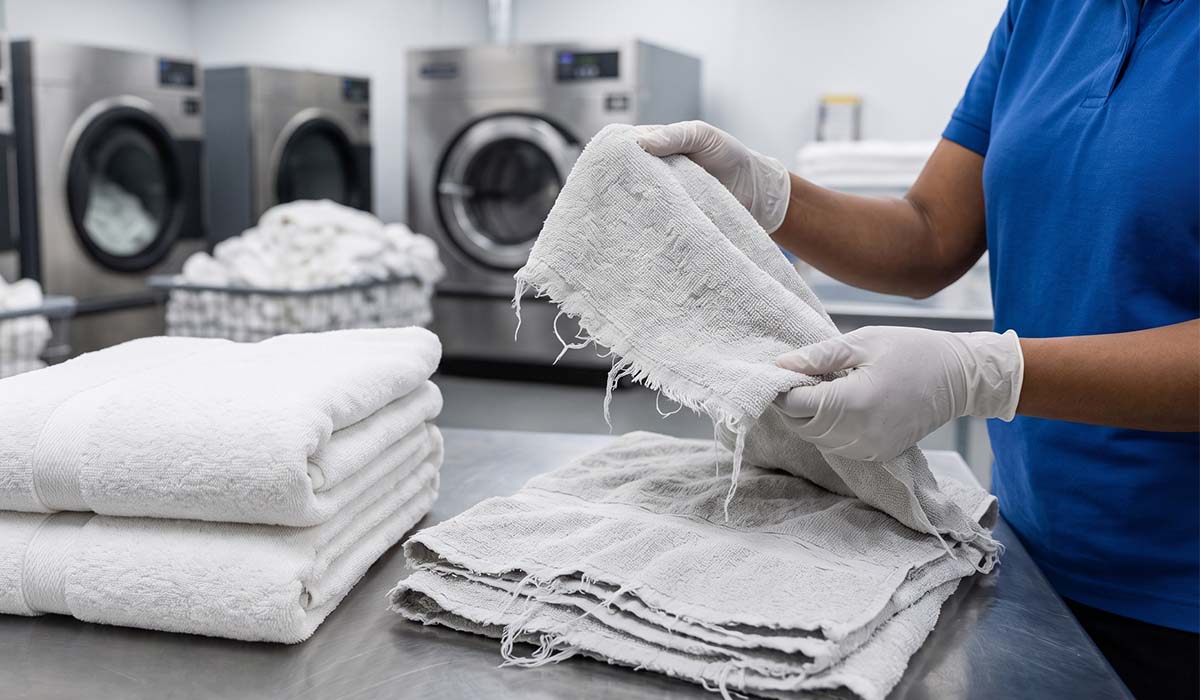
Zero-twist towels are extremely soft and absorbent, but that does not automatically make them a good choice for hotels. Their low-twist construction can provide less yarn strength, higher pilling in washers, and lower structural stability than ring-spun towels, an important consideration when towels face frequent commercial washing and drying.
For hotels, ring-spun towels offer a more practical balance of softness, absorbency, durability, and repeated-laundry performance. This is why DZEE Textiles uses ring-spun towel constructions for commercial hospitality use.
Table of Contents
Are Zero Twist Towels Bad for Hotels?
Zero twist towels are not inherently bad, but they are often a poor fit for hotels that prioritize long service life and repeated commercial laundering. Their main advantage is exceptional softness and absorbency. The downside is that the low- or no-twist pile structure provides less structural strength than conventional twisted-yarn constructions.
A hotel buyer should therefore evaluate towels based on more than just initial softness.
| Factor | Zero-Twist Towels | Ring-Spun Towels |
| Initial softness | Excellent | Excellent |
| Absorbency | Very high | High |
| Yarn structure | Very low/no twist | Twisted yarn |
| Structural durability | More dependent on construction | Generally stronger |
| Commercial laundering | Requires careful specification | Well suited |
| Guest comfort | Excellent | Excellent |
| Long-term operating priority | Softness-focused | Durability + comfort |
The important point is that yarn construction is only one part of towel performance. GSM, yarn quality, ply, pile height, weave, hems, finishing, and laundering conditions all affect the final result. Many recent researches confirms that terry-towel performance depends on multiple construction variables, including pile yarn type, fabric weight, thickness, and weave structure.
Why Zero Twist Towels Can Be Problematic in Hotels

When we talk about hotels, a lot of factors matter. Whether the towels will feel soft to the guest & yet perform well in commercial laundering.
-
Lower twist means less yarn reinforcement
Yarn twist holds cotton fibers together. Zero-twist construction keeps fibers open, making towels exceptionally fluffy, soft, and absorbent. However, a comparative textile study showed this structure reduces tensile strength compared to twisted pile.
For hotels processing towels repeatedly, this lower strength presents operational challenges. The open fibers lead to increased shedding, pilling, and potential laundry machinery blockages, resulting in faster degradation under commercial mechanical stress than ring-spun options.
Operational Challenges with Zero-Twist Towels
- Increased Shedding and Pilling: Untwisted fibers lack structural cohesion, leading to excessive linting and surface pilling under mechanical stress.
- Equipment Damage: High volumes of shed lint can clog laundry filters and damage commercial washer-extractors and folding equipment.
- Accelerated Wear: Harsh industrial laundry processes degrade open-fiber structures faster than reinforced ring-spun yarns, shortening the towel’s service life.
-
Commercial laundry is much harsher than household washing
Commercial laundering is much harsher than regular washing cycles for towels.
- Excessive shedding and pilling: Untwisted fibers lack cohesion, leading to significant linting under mechanical stress.
- Equipment damage: High lint volumes can clog filters and damage commercial washer-extractors and folding machinery.
- Accelerated wear: Harsh industrial processes cause faster structural degradation compared to more durable ring-spun options.
-
Fiber shedding and pile damage can become an operational concern
The open fiber structure that creates the characteristic zero-twist softness can also make fiber shedding and pile stability important considerations.
Excessive lint means more than an untidy laundry filter. It can contribute to housekeeping complaints, affect the towel’s appearance, and signal progressive fiber loss.
For a commercial towel program, procurement teams should ask suppliers about:
- Yarn construction
- Pile stability
- Tensile strength
- Shrinkage
- Laundering performance
- Hem construction
- Pilling and linting behavior
- Recommended wash conditions
Do not assume that a high GSM automatically means a durable towel.
Ring Spun vs. Zero Twist Towels for Hotels
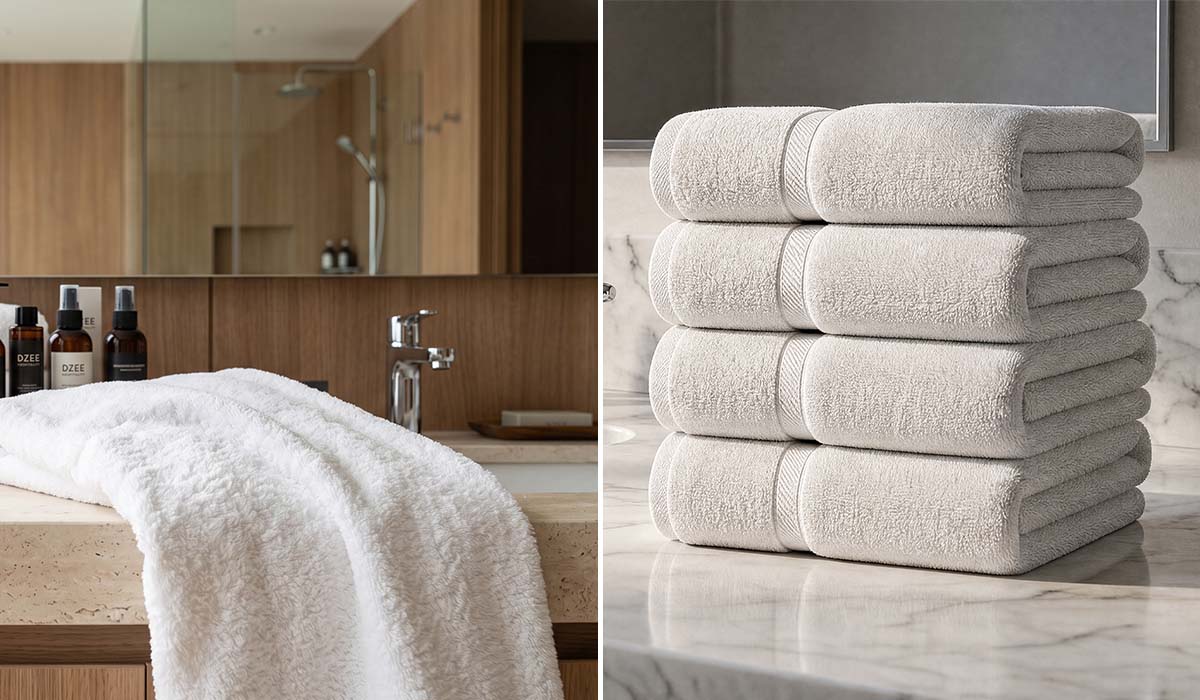
Ring-spun towels are generally a more practical choice when a hotel needs a balance of softness, absorbency, durability, and repeated-laundry performance.
That is why DZEE’s hospitality towel range is centered on 100% ring-spun cotton and commercial-grade terry constructions. DZEE describes its wholesale hotel towels as designed for frequent wash cycles, with its collection including bath, pool, gym/spa, salon, and kitchen towels.
Learn in detail about ring-spun cotton towels with DZEE’s guide: What Are Ring-Spun Cotton Towels? Hoteliers Guide
What Should Hotels Look for When Buying Hotel Towels?
For most hotel towel programs, prioritize:
- Durability through repeated laundering
- Absorbency for guest performance
- Softness for guest comfort
- Stable dimensions after washing
- Strong hems and stitching
- Consistent quality across bulk orders
- Appropriate GSM for the property
- Reliable replacement availability
This is a better procurement framework than selecting towels based solely on how fluffy they feel in a sample room.
Learn More: Complete Beach Towels Buying Guide for Your Hotel
Why DZEE Uses Ring-Spun Towels for Commercial Hospitality
DZEE Textiles designs hotel towels specifically for commercial property demands rather than retail luxury.
The lineup features collections like:
Our Belem bath towels offer a luxurious 2-ply 100% combed cotton option at 600 GSM.
The range also covers pool, gym/spa, salon, and kitchen towels, enabling buyers to standardize all needs through a single commercial supplier.
Explore DZEE’s wholesale hotel towel collection
Are Ring-Spun Towels Better for Commercial Laundry?
For many hotel operations, yes. Ring-spun construction offers a practical foundation for producing towels that combine softness with stronger yarn integrity.
However, procurement teams should avoid treating “ring-spun” as a complete quality specification.
A durable hotel towel is the result of the entire construction, including:
- Fiber quality
- Yarn count
- Yarn twist
- Single- or two-ply construction
- Terry loop design
- GSM
- Pile height
- Ground construction
- Hem design
- Stitching
- Finishing
- Shrinkage control
- Laundry compatibility
This distinction is important because a high-quality ring-spun towel can outperform a poorly constructed towel regardless of the label on the yarn.
Frequently Asked Questions
-
Why are zero twist towels bad for hotels?
They are not universally bad, but their low/no-twist pile can sacrifice some structural strength in exchange for exceptional softness and absorbency. That trade-off can be less suitable for intensive commercial laundering.
-
What is the difference between ring spun and zero twist towels?
Ring-spun towels use twisted yarn, which provides fiber cohesion and structural reinforcement. Zero-twist towels use an extremely low- or no-twist pile construction that creates a softer, more open structure.
-
Are ring-spun cotton towels good for hotels?
Yes. Ring-spun cotton is a practical choice for hotel towels because it can provide a strong combination of softness, absorbency, yarn integrity, and commercial durability when properly constructed.
-
Why do zero-twist towels lint so much?
The open fiber structure of zero-twist pile can make fiber shedding more noticeable, particularly during early laundering. Actual linting depends on yarn, fiber, finishing, construction, and laundry conditions.
-
What are the most durable bath towels for hotels?
Look for commercial-grade towels with suitable yarn construction, strong terry loops, reinforced hems, appropriate GSM, stable dimensions, and construction intended for repeated institutional laundering.
7. How can hotels prevent towels from wearing out quickly?
Use towels designed for commercial laundering, follow the manufacturer’s wash recommendations, avoid excessive chemical or mechanical stress, separate incompatible laundry loads, and monitor towels for thinning, damaged loops, frayed hems, and dimensional changes.
8. Is higher GSM always better for hotel towels?
No. Higher GSM generally means more material and a heavier, potentially more luxurious towel, but it can also increase drying requirements. Hotels should select GSM according to guest expectations, laundry capacity, drying time, and operating costs.
9. What yarn type is best for hospitality towels?
For many commercial hotel applications, ring-spun cotton is a strong starting point. The final specification should also consider fiber quality, ply, GSM, pile construction, finishing, hems, and the property’s actual laundry process.
Final Words
Although soft and absorbent, zero-twist towels often struggle with heavy commercial laundering due to their lack of structural reinforcement. Therefore, DZEE Textiles manufactures ring-spun towels for hotels to prioritize overall longevity and performance over short-term softness. Explore DZEE Textiles’ wholesale hotel towel collection to compare ring-spun options for your property.